

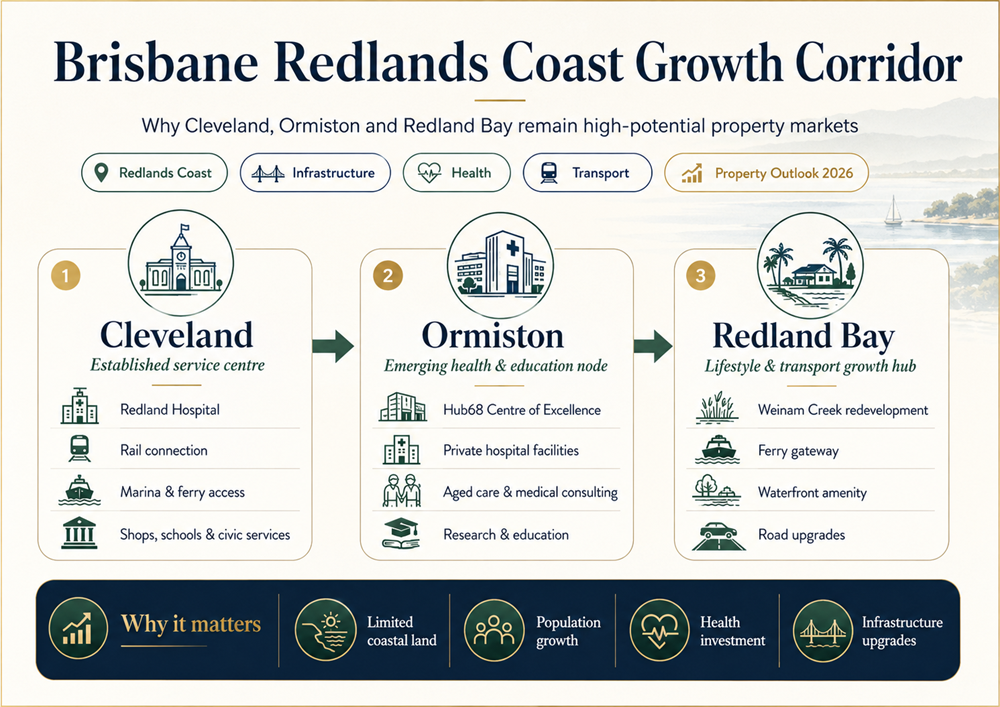
South East Queensland continues to attract buyers looking for lifestyle, space, infrastructure and long-term capital growth. This article looks at why Cleveland, Ormiston, Redland Bay and the broader Redlands Coast remain high-potential Real Estate markets, supported by land scarcity, population growth, health investment, transport upgrades and tight rental demand.
Why Cleveland, Ormiston and Redland Bay Remain High-Potential Real Estate Markets
South East Queensland continues to attract buyers looking for lifestyle, space, infrastructure and long-term capital growth. Cleveland, Ormiston, Redland Bay and the broader Redlands Coast remain well positioned because they combine bayside scarcity, population growth, health investment, transport upgrades and tight rental demand.
This is not a hype piece. It is a measured look at the local fundamentals supporting the Redlands Coast Real Estate market.

Infographic: Cleveland, Ormiston and Redland Bay growth corridor - lifestyle, infrastructure, health and transport drivers.
The Redlands Coast growth story
Cleveland and Redland Bay are not speculative “boom suburb” stories. Their appeal is based on practical fundamentals: land, lifestyle, services, transport, population growth and limited coastal supply.
Cleveland is the established civic and service centre of the Redlands. It has rail access, shopping, hospitals, schools, marina access, government services, ferry connections and proximity to the bay.
Redland Bay is a growing residential and lifestyle corridor. It benefits from waterfront amenity, ferry access to the Southern Moreton Bay Islands, new housing demand and ongoing infrastructure investment around Weinam Creek and the Cleveland–Redland Bay Road upgrade.
Why the area has long-term potential
Land values show underlying demand
Recent Queensland Government land valuation data confirms strong underlying demand across Redland City. The 2026 land valuations showed an overall 20% increase in Redland City land values compared with the previous 2024 valuation.
This matters because land value growth is one of the clearest signals of long-term demand. It reflects buyer competition, limited supply, location quality and confidence in the area.
For established suburbs like Cleveland, land content remains a major driver. Detached homes on good blocks are difficult to replace, especially close to services, schools, shops, hospitals, rail and the bay.
Population growth supports housing demand
Redland City’s estimated resident population reached 172,831 as at 30 June 2025, increasing by 1.7% over the previous year. This confirms steady demand for housing, infrastructure, health services and local employment.
The Redlands also benefits from the broader South East Queensland growth story. As Greater Brisbane grows, lifestyle suburbs with access to water, nature, schools and services become more attractive to families, downsizers and long-term investors.
Health infrastructure is a major local anchor
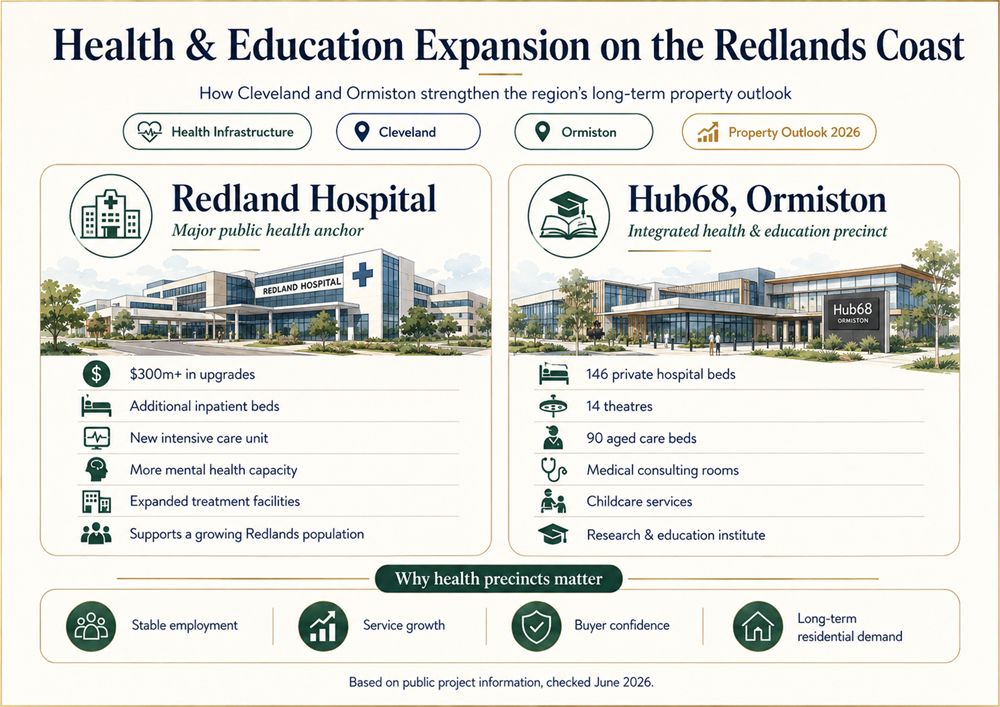
Infographic: Redland Hospital and Hub68 Ormiston strengthen the Redlands Coast health and education corridor.
Health investment is one of the strongest long-term positives for Cleveland, Ormiston and the surrounding Redlands Coast. The Redland Hospital expansion has delivered more than $300 million in upgrades, including additional inpatient beds, a new intensive care unit, more mental health capacity and expanded treatment facilities.
Nearby Ormiston adds another important layer to the local growth story. The Hub68 Centre of Excellence is planned as a major health and education precinct, with private hospital facilities, aged care, operating theatres, childcare, education, research and medical consulting uses. The project has also been reported as a $750 million health and education precinct on a four-hectare Ormiston site.
Health precincts are important for Real Estate markets because they create stable employment and consistent local demand. Doctors, nurses, allied health workers, support staff, contractors, students, researchers and service providers all contribute to the local economy.
As the Redlands population grows and ages, local healthcare capacity becomes more important. This supports Cleveland’s role as an established service hub, strengthens Ormiston’s position as an emerging health and education node, and adds depth to the broader Redlands Coast Real Estate market.
Transport upgrades are improving local connectivity
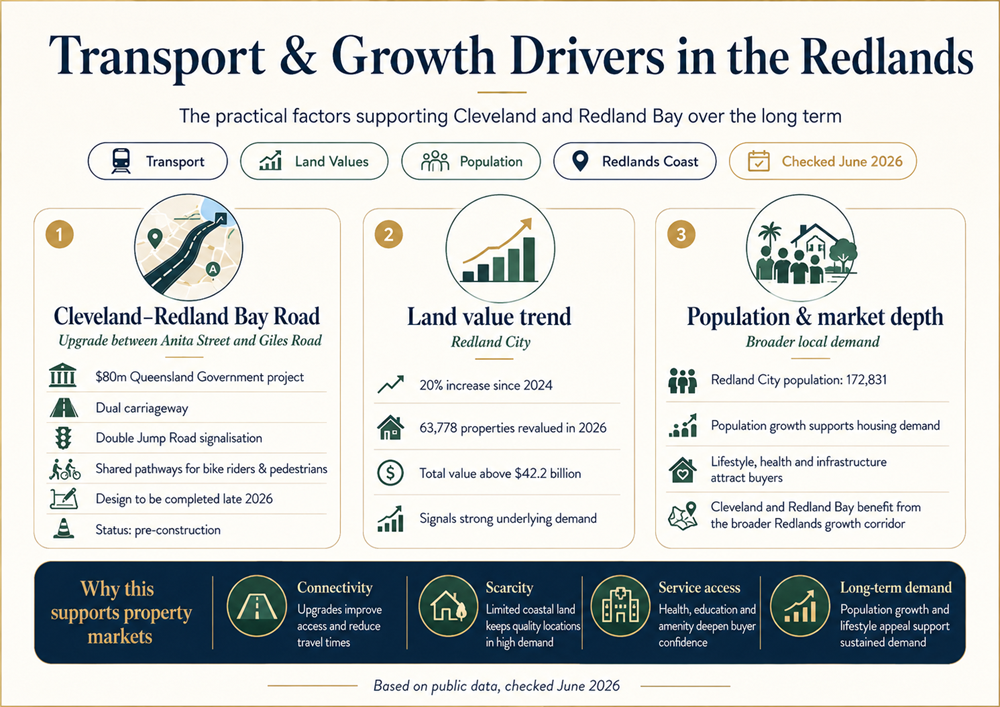
Infographic: transport, land values and population growth are practical long-term drivers for Cleveland and Redland Bay.
Transport access remains one of the key issues for Redlands. The area offers strong lifestyle appeal, but road capacity, commuting and access to Brisbane are important considerations for buyers, tenants and local businesses.
The Cleveland–Redland Bay Road upgrade between Anita Street and Giles Road is designed to duplicate lanes, improve intersections, add shared pathways and improve traffic flow. The project is fully funded by the Queensland Government, with design expected to be completed in late 2026.
This project is especially relevant for Redland Bay and the southern Redlands growth corridor. Better road capacity supports population growth, improves daily access and makes the area more practical for families, commuters and service providers.
Cleveland also benefits from being the rail-connected centre of the Redlands. The Cleveland Centre Local Area Transport Plan 2026–2046 sets a long-term framework to improve access, safety, connectivity and walkability around Cleveland.
Redland Bay does not have rail access, but it benefits from road, bus and ferry infrastructure, particularly through the Weinam Creek redevelopment, which is intended to improve ferry terminal access, parking and waterfront infrastructure.
Redland Bay is becoming a stronger activity hub
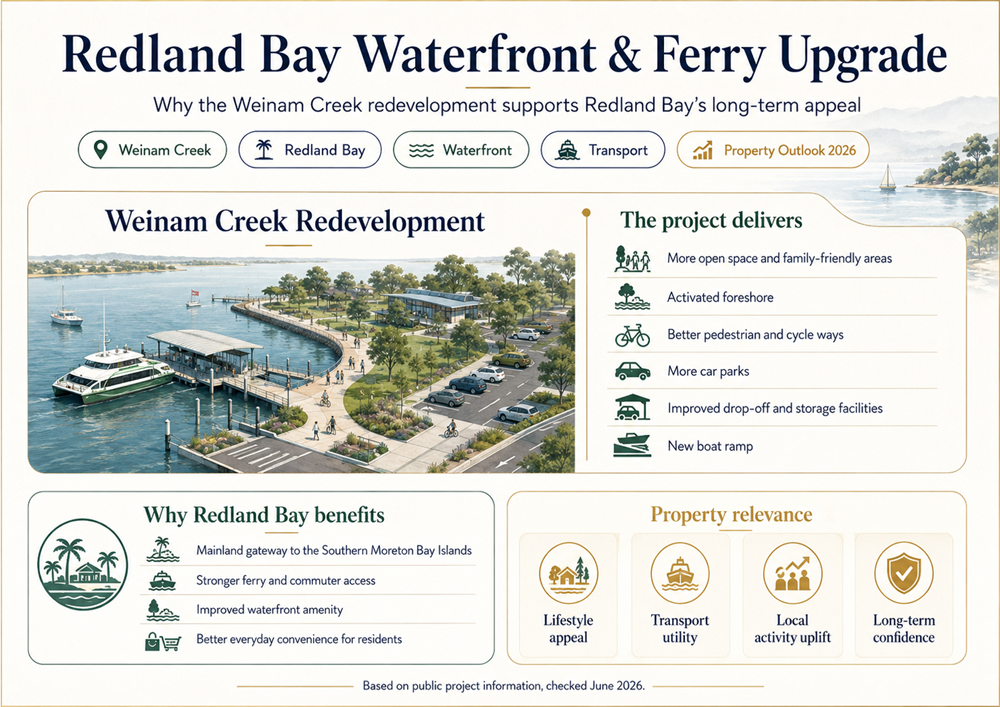
Infographic: Weinam Creek redevelopment supports Redland Bay’s role as a waterfront and ferry-gateway activity hub.
Redland Bay has shifted from being seen mainly as a quiet bayside suburb to becoming a more important residential, waterfront and transport hub.
The Weinam Creek Priority Development Area is one of the most important local projects. It is designed to improve the Redland Bay waterfront, ferry terminal access, commuter parking and public infrastructure.
Several parts of the broader project have already progressed, including additional commuter parking, a pedestrian footbridge, a recreational boat ramp and early civil works. In April 2026, the Queensland Government commenced a compulsory land acquisition process to support delivery of a multi-storey car park at the Weinam Creek ferry terminal.
Housing strategy points to a more mature market
The Redland Housing Strategy 2024–2046 aims to increase housing choice in suitable locations while protecting the character and lifestyle qualities of the Redlands Coast.
This reflects the reality that Redlands is growing and changing. Not every household wants or can afford a large detached home. Over time, more townhouses, units and smaller homes are likely to be needed around activity centres and transport corridors.
For Real Estate owners and investors, this has two sides. More supply can moderate price pressure in some segments, but it can also strengthen local centres, attract more residents and improve the depth of the local market.
Toondah Harbour remains an opportunity, not the whole story
The previous Toondah Harbour redevelopment proposal did not proceed in its original form, but that should not be treated as the end of Cleveland’s growth story.
Toondah Harbour remains an important transport and waterfront precinct because it connects the mainland to North Stradbroke Island / Minjerribah. Any future plan will need to balance transport, tourism, retail, housing, environmental protection and community expectations.
The important point is that Cleveland’s fundamentals do not depend on one project. The suburb already has rail access, hospitals, schools, shops, marina access, ferry links, government services, community infrastructure and bayside lifestyle appeal.
Rental demand remains supportive
Rental demand across the Redlands remains strong, especially for family homes. Population growth, limited supply, lifestyle demand and affordability pressure all support the rental market.
This is important for investors because rental income helps support holding power during periods of higher interest rates. A Real Estate market with both owner-occupier demand and tenant demand is generally more resilient than one relying only on speculative capital growth.
Large family homes in established bayside suburbs are particularly attractive because they appeal to tenants who want space, schools, parks, lifestyle and longer-term stability.
Growth drivers and risks
| Factor | Why it supports the area | What to watch |
|---|---|---|
| Land scarcity | Established bayside land is limited and difficult to replace. | Property-specific overlays, flooding, storm tide and site constraints still matter. |
| Population growth | More residents support housing, services and infrastructure demand. | Infrastructure must keep pace with growth. |
| Health investment | Hospitals and health services create stable employment and local demand. | Benefits are long-term rather than instant price catalysts. |
| Transport upgrades | Road, ferry and access improvements make the area more practical. | Congestion remains a concern if growth outpaces delivery. |
| Housing strategy | More diverse housing can strengthen local centres and support growth. | More supply may moderate growth in some Real Estate types. |
| Rental demand | Tight rental conditions support investor holding power. | Cash flow still depends on interest rates, insurance, rates and maintenance. |
Risks that should not be ignored
The Redlands Coast growth story is strong, but it is not risk-free. A realistic Real Estate view should include both upside and downside factors.
Interest rates
Higher interest rates reduce borrowing capacity and can slow buyer demand, especially for higher-value family homes. This is the biggest short-term risk for price growth.
Affordability
Cleveland and Redland Bay are no longer cheap markets. As prices rise, the buyer pool becomes more selective. Future growth is likely to be more measured than during the strongest post-pandemic years.
Infrastructure pressure
Population growth needs to be matched by road capacity, schools, health services, parking, drainage and community facilities. If infrastructure lags, buyer sentiment can be affected.
Coastal and environmental factors
Redlands is a bayside region, so flood, storm tide, insurance and environmental overlays should always be reviewed at a property-specific level.
Outlook: measured confidence
Cleveland and Redland Bay remain high-potential Real Estate markets because they combine several important fundamentals: lifestyle appeal, limited coastal land, population growth, infrastructure investment, health-sector expansion and tight rental demand.
Cleveland has the established-centre advantage. It offers rail, hospitals, shops, schools, marina access, ferry links and community infrastructure.
Redland Bay has the growth-corridor advantage. It offers waterfront renewal, ferry infrastructure, road upgrades, population growth and stronger local activity around Weinam Creek.
The best-performing properties are likely to be those with strong land content, good presentation, practical layouts, access to services and limited exposure to flooding or major planning constraints.